


_edited.jpg)
The Food Preservatives That Keep Food on the Shelf Way Too Long
- Cathy Weaver
- 3 days ago
- 8 min read

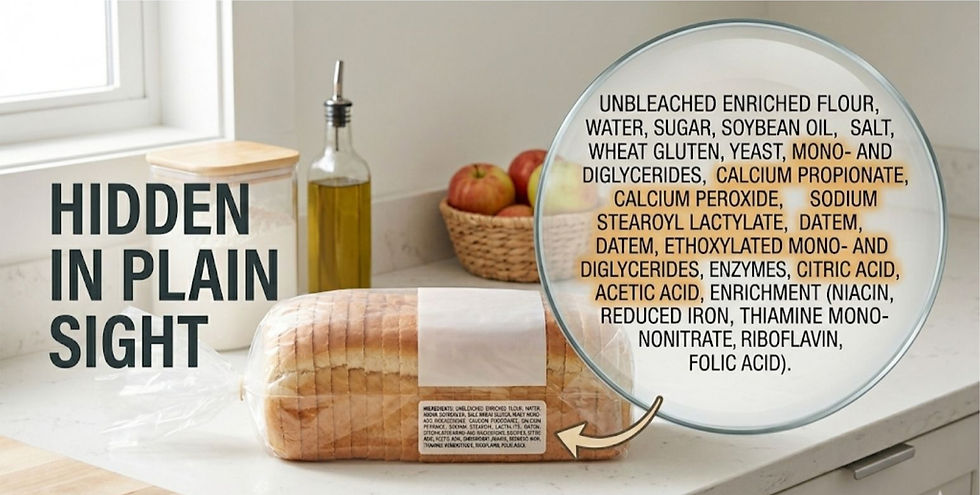
Here's What's Keeping Your Food Fresh
`

Deep Dive: The Science and Health Impact of Common Food Preservatives
Food preservatives are among the most studied additives in the food supply — and among the most contested. Regulatory approval, which typically means "not demonstrably harmful at the tested dose in isolation," is not the same as a clean bill of health. Understanding what preservatives actually are, how they work chemically, and what the research shows about long-term exposure gives you a more accurate picture than the label ever will.
---
What Food Preservatives Are and How They Work
Preservatives prevent food spoilage through two primary mechanisms: antimicrobial action and antioxidant activity. Antimicrobial preservatives — such as sodium benzoate, nitrites, and calcium propionate — inhibit the growth of bacteria, mold, and yeast by disrupting cellular membranes or interfering with microbial metabolism. Antioxidant preservatives — such as BHA, BHT, and TBHQ — prevent oxidative rancidity by interrupting the chain reactions that cause fats and oils to degrade.
Both functions extend shelf life. Neither adds nutritional value. The compounds used for these purposes today are largely synthetic, developed in the mid-20th century as industrial food production scaled up and distribution chains lengthened. Most were approved under regulatory frameworks that evaluated them individually at specified dose limits — not in combination, and not across the full range of products in which they now appear simultaneously.
BHA and BHT: Petroleum-Derived Antioxidants
Butylated hydroxyanisole (BHA) and butylated hydroxytoluene (BHT) are phenolic antioxidants synthesized from petroleum. They function by donating hydrogen atoms to free radicals, interrupting the oxidative cascade that causes fats to become rancid.
BHA has been classified as a possible human carcinogen (Group 2B) by the International Agency for Research on Cancer (IARC), based primarily on animal studies showing forestomach tumor formation in rats and hamsters. The human forestomach is a different anatomical structure, which complicates direct extrapolation — but the classification reflects genuine concern about the compound's biological activity. The National Toxicology Program in the United States has also identified BHA as "reasonably anticipated to be a human carcinogen."
BHT presents a more complicated picture. Some animal studies have shown tumor-promoting activity at high doses; others have demonstrated tumor-inhibiting effects at lower levels, possibly through antioxidant mechanisms. The divergence in findings has made definitive regulatory conclusions difficult, and BHT remains approved in both the US and EU at current permitted levels.
Both compounds are fat-soluble and bioaccumulative, meaning they concentrate in fatty tissues with repeated exposure. Neither has been adequately studied in the context of lifelong dietary exposure across the full range of products in which they appear. The EU requires products containing BHA or BHT to carry the warning "may have an adverse effect on activity and attention in children," a precautionary label not required in the United States.
Sodium Benzoate and the Benzene Formation Problem
Sodium benzoate (E211) functions as an antimicrobial preservative in acidic environments — pH below 4.5 — by disrupting cell membrane function and inhibiting key metabolic enzymes in microorganisms. It is widely used in beverages, condiments, and acidic food products.
The primary concern with sodium benzoate is not the compound itself but its interaction with ascorbic acid (vitamin C) under certain conditions. When sodium benzoate and ascorbic acid are present together in an acidic aqueous solution and exposed to heat or UV light, a reaction can produce benzene — a known human carcinogen classified as Group 1 by IARC, with well-established links to leukemia and other blood cancers.
The FDA has been aware of this reaction since at least the early 1990s. Agency testing conducted in 2005-2006 found benzene levels above the 5 parts per billion drinking water standard in several beverage products. Following industry collaboration, many manufacturers reformulated. However, both sodium benzoate and ascorbic acid continue to appear together in numerous products, and no regulatory requirement has been established to prevent their co-use.
The relevant question for consumers is not whether a given product exceeds a safety threshold — it's whether there is any reason to accept even low-level benzene exposure from a food product when alternatives exist.
TBHQ: Regulatory Approval and Remaining Concerns
Tertiary butylhydroquinone (TBHQ) is a synthetic phenolic antioxidant derived from butane. Like BHA and BHT, it functions by interrupting oxidative chain reactions in fats and oils. The FDA permits its use at concentrations up to 0.02% of the fat and oil content of a food product.
Animal studies conducted at doses above the permitted level have shown precancerous lesions in the stomachs of rats, as well as DNA strand breakage in certain cell lines. These findings have not been replicated at doses equivalent to typical human dietary exposure, which is why regulatory approval has been maintained. However, the safety evaluations for TBHQ — like most synthetic food additives — were conducted product by product, not across aggregate dietary exposure.
Research published in the International Journal of Molecular Sciences has raised concerns about TBHQ's potential immunotoxic effects, including disruption of T-cell function and promotion of Th2 immune responses associated with allergic disease. These findings remain preliminary and contested, but they introduce a dimension of concern beyond the carcinogenicity question that dominated earlier regulatory review.
TBHQ is also notable for the breadth of products in which it appears. Because it stabilizes frying oils effectively, it is present in a wide range of fast food and commercially fried products in addition to packaged goods. A person who eats multiple processed food products daily — each containing a "safe" level of TBHQ — may be exposed to amounts that existing safety data do not adequately address.
Nitrates and Nitrites: Preservation Chemistry and Carcinogenicity
Sodium nitrate (NaNO₃) and sodium nitrite (NaNO₂) have been used in meat curing for centuries, initially as components of crude salt mixtures and more recently as purified additives. Nitrite functions as the active antimicrobial agent, inhibiting the growth of Clostridium botulinum and other anaerobic pathogens through mechanisms that include disruption of iron-sulfur proteins essential to bacterial metabolism. Nitrite also reacts with myoglobin in meat tissue to form nitrosylmyoglobin, producing the characteristic pink color associated with cured meats.
The cancer risk associated with processed meat consumption arises primarily from the formation of N-nitroso compounds (NOCs), including nitrosamines and nitrosamides. These compounds form when nitrites react with secondary amines — derived from the amino acids in protein — under acidic conditions (as in the stomach) or at high temperatures (as during frying, grilling, or roasting). N-nitroso compounds are among the most potent chemical carcinogens identified in laboratory studies.
In 2015, the World Health Organization's International Agency for Research on Cancer classified processed meat as a Group 1 carcinogen — the highest classification, indicating sufficient evidence of carcinogenicity in humans — based on an evaluation of over 800 studies. The evidence was strongest for colorectal cancer, with each 50-gram daily portion of processed meat associated with an approximately 18% increase in risk.
Many manufacturers now market "uncured" products using celery powder, celery juice, or sea salt as natural sources of nitrate. These products undergo the same conversion: bacterial action on vegetable-derived nitrates produces nitrites chemically identical to those added directly. The end product contains comparable or sometimes higher levels of nitrite than conventionally cured meats. The USDA permits these products to be labeled "uncured" and "no nitrates or nitrites added" even when they contain celery-derived nitrites — a labeling distinction that the American Meat Science Association and multiple consumer groups have criticized as misleading.
Calcium Propionate: Antimicrobial Action in Commercial Baked Goods
Calcium propionate (E282) is a salt of propionic acid used primarily in commercial bread and baked goods to inhibit mold and bacterial growth by lowering the water activity available to microorganisms and disrupting fungal cell metabolism. It is responsible for the extended shelf life of commercial sandwich bread — products that would otherwise show visible mold within 3 to 5 days can remain shelf-stable for two to three weeks.
Propionic acid occurs naturally in small amounts in some fermented foods, which has contributed to its perception as a relatively benign preservative. However, research published in the journal Cell Metabolism (2019) found that propionate administration in both mice and humans triggered a hormonal cascade — including elevated glucagon and insulin resistance markers — suggesting metabolic effects at doses relevant to regular dietary consumption. The study generated considerable discussion and has not yet been replicated at scale, but it raised questions about long-term metabolic consequences that existing regulatory reviews had not considered.
Separate research has examined neurological effects, particularly in children. A double-blind, crossover study published in the Journal of Paediatrics and Child Health found significant increases in irritability, restlessness, and sleep disturbance in children following calcium propionate consumption compared to placebo. These behavioral effects resolved within days of removal from the diet. The mechanism proposed involves propionate's capacity to cross the blood-brain barrier and influence neurotransmitter metabolism.
The Cumulative Exposure Problem
A fundamental limitation of current food additive safety frameworks is that they evaluate compounds individually, in isolation, against a single-product exposure model. The actual dietary exposure pattern for most people eating a processed food diet involves dozens of additives daily, across multiple products, with interactions between compounds that have not been studied.
The phenomenon of additive interaction — where two or more compounds produce effects greater than their individual contributions would predict — is well-documented in toxicology but largely absent from food additive regulatory review. The combination of BHA, BHT, and TBHQ in a single snack food, for example, has not been studied as a combined exposure. The sodium benzoate and vitamin C interaction described above is one of the few cases where a specific additive combination has been examined, and it produced a result — benzene formation — that the individual safety reviews had missed entirely.
This does not mean that processed food is uniformly dangerous. It means that "safe at the tested dose, in isolation" is a narrower claim than most consumers understand it to be, and that building a diet around foods that don't require preservatives is a more reliably protective approach than relying on regulatory thresholds set under conditions that don't reflect real-world dietary patterns.
Regulatory Differences Between the United States and European Union
The United States and European Union operate under meaningfully different regulatory philosophies for food additives. The EU applies a precautionary principle: additives must be demonstrated safe before approval, and the burden of proof rests with manufacturers. The US applies a GRAS (Generally Recognized as Safe) framework: substances can enter the food supply without formal FDA review if the manufacturer determines them to be safe, and the FDA relies on voluntary notification rather than mandatory pre-market approval.
Several preservatives permitted in the US are either banned or more tightly restricted in the EU. BHA, while permitted in both jurisdictions, carries mandatory consumer warning labeling in EU products that is not required in the US. The EU has more restrictive limits on nitrite levels in processed meats and has moved to phase out certain nitrite applications, citing cancer risk. Propionate limits in baked goods vary by country within the EU, with some member states applying more conservative thresholds than the EU-wide standard.
These regulatory differences reflect genuine divergence in how the two systems weigh scientific uncertainty — not evidence that one system is definitively correct. They do suggest, however, that the US regulatory standard for preservative safety is not the most precautionary framework available, and that the evidence base supporting many approvals is less comprehensive than the label "generally recognized as safe" implies.
For informational purposes only. Always consult a qualified healthcare provider regarding specific health concerns related to diet and food additives.

Comments